Hurricane Deck Preparation in Myrtle Beach: What Actually Helps
A hurricane doesn't treat a deck like part of the house. It treats it like a loose edge: a horizontal surface it can push on, pull up, and pry at the wall with. Most of what protects a Grand Strand deck in a named storm happens in the two days before landfall, and nearly all of it is free. This is the list we'd run at our own houses.
Why hurricane wind gets under a deck
Wind doesn't simply push on a structure; it accelerates around it. When a gust meets your house it squeezes past the corners and beneath anything elevated, and air that speeds up drops in pressure. Under an attached deck the incoming wind piles up and shoves upward, while the faster air racing across the top pulls in the same direction. The net force on the deck is up — and up is the one direction most of its connections were never really asked to resist. A frame spends its whole life carrying people and furniture downward. A tropical system spends hours loading it in reverse, cycling every fastener like a pry bar in slow motion, and it doesn't take a major hurricane to start that work.
The quiet virtue of an ordinary deck is the gap between boards. Those slots bleed pressure from below, so the surface never behaves like a solid wing. That's also why the easiest mistake in storm prep is sealing them by accident: an outdoor rug left down, a tarp lashed over the furniture, a sheet of plywood stored flat on the boards. Each one converts a vented surface into a sail. Elevated decks on raised beach houses feel all of this first, because they sit in cleaner, faster wind with nothing but open air underneath. It's also why Surfside Beach makes its flood-zone decks stand three feet above the base flood elevation.
The pre-storm checklist: remove, strap, or leave
The second physics problem is blunter. At hurricane wind speeds, anything loose on a deck becomes ammunition. A patio chair that takes flight doesn't just leave the yard; it arrives somewhere — through a slider, a neighbor's window, your own siding. After a storm, adjusters see far more damage caused by flying deck furniture than damage to the decks themselves, and almost every bit of it was preventable in an afternoon. When a named storm shows up in the Horry County forecast, work the deck in this order:
- Carry in anything you can lift with one hand. Cushions, umbrellas, planters, rugs, string lights, grill tools, toys. If it's easy for you, it's easy for the wind.
- Take down the umbrella and any shade sail first. They are engineered to catch air, and they'll keep doing their job whether or not anyone is holding on.
- Strap what you can't move. Flip heavy tables upside down so gusts can't load the underside of the top, then ratchet-strap them low to a post. Low and flat survives; tall and light travels.
- Handle the grill correctly. Close the propane valve, leave the tank outdoors in a low, secured spot — never inside the house or garage — and roll the grill body into shelter or strap it down.
- Open up the drainage. Sweep the board gaps, clear the base of the stairs, and pull leaves and debris off the frame so rain leaves the structure as fast as it lands.
- Latch or pull the gate. A gate swinging free in a hurricane will hammer its own hinges out of the rail long before the wind peaks.
None of this needs a contractor, a purchase beyond a couple of ratchet straps, or more than a few hours. It's the highest-return storm work on the whole property, and it's the one part you can still do well the day before landfall.
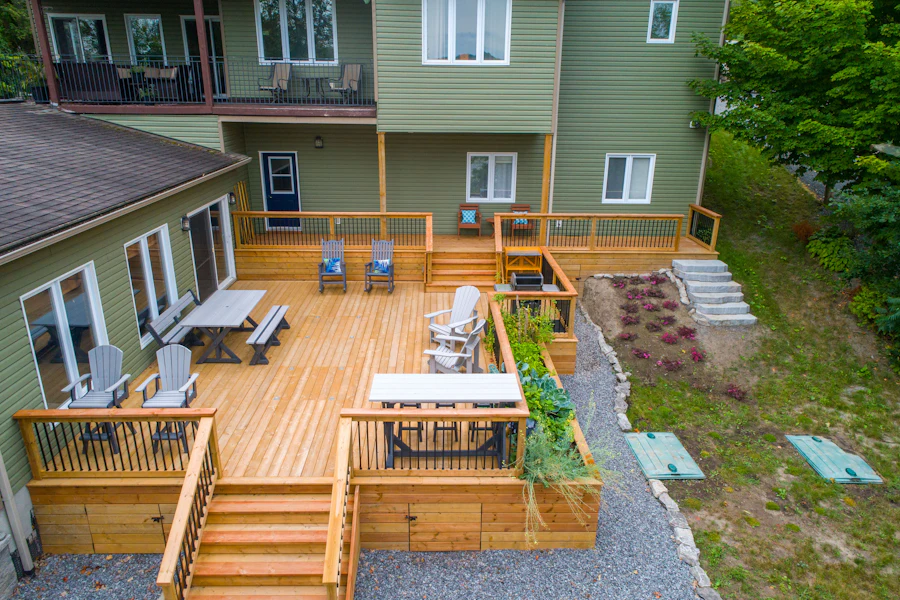
The ledger and its flashing: the connection a storm tests hardest
One check can't wait for the forecast cone, because fixing what it finds takes longer than a watch-to-warning window: the ledger. That's the horizontal member bolted against the house that carries roughly half of an attached deck's weight, and during a storm it carries something worse — leverage. Every upward and sideways gust that loads the deck delivers its force to the house through that single connection. A ledger through-bolted into sound framing shrugs the abuse off. A ledger held by nails or a scatter of deck screws, or bolted into wood that years of failed flashing have quietly softened, is the hinge the whole structure fails around.
Flashing is the ledger's bodyguard. It's the bent metal that laps over the ledger's top edge and tucks up behind the house's weather barrier, so rain sheets past the connection instead of soaking into it. Where flashing is missing, cut short, or replaced with a bead of caulk, water sits against the band joist after every routine thunderstorm, and by the time a hurricane arrives the bolts are gripping wood with the authority of a wet sponge. From the yard, the early warnings are readable: stained or bubbling paint on the wall under the deck, daylight visible behind the ledger, or perceptible movement at the house when someone bounces mid-span. If any of that looks doubtful, book a repair evaluation in the calm months, on purpose. June through November is a poor season to discover it on a deadline.
After the storm: what you can check from the yard
Once the roads reopen and the deck has drained, resist the urge to test it with a full cookout. Walk the yard first. Most meaningful storm damage to a deck is visible from the ground if you know where to look:
- Sight down the railing line. It should run straight. A new bow, sway, or lean means the frame beneath it moved.
- Study the gap where deck meets house. If it looks wider than you remember, or the flashing is bent, lifted, or missing, the ledger connection took a hit.
- Check the posts at the ground. Washout around a footing, a post sitting off-center on its base, or freshly disturbed soil all say the foundation shifted.
- Stand at the stairs. Stair carriages rack before the main frame does; a bottom step that no longer meets the ground squarely is an early confession.
- Trust any new bounce or noise. A deck that suddenly feels different underfoot is telling you the truth. Believe it the first time.
- Flag anything floodwater touched. If surge or river flooding reached the framing — a live possibility on marsh-front lots in Murrells Inlet and river lots around Conway — the deck deserves a professional look even if nothing appears to have moved.
The dividing line is movement. Debris dents, scoured finish, a cracked board, a mangled railing section: that's damage you can see completely and photograph safely for the insurance file. Anything involving the frame's position — a shifted post, a widened ledger gap, an undermined footing, a lean that wasn't there in August — is different, because a structure that has moved once can finish the job with people standing on it. Stay off it and have it assessed; that same visit produces the written scope your insurance paperwork will ask for anyway.
Repairable or done: how the call actually gets made
The repair-or-replace decision after a storm follows the same logic we use the rest of the year, just on a faster clock. Damage sitting on top of a sound frame is repairable: broken boards, railing runs, stair treads, torn skirting, connections that need re-tightening. Those are contained jobs with contained prices. Damage to the geometry is another animal. A frame racked out of square, posts pushed off their footings, or a ledger that visibly pulled from the house means the structure spent hours flexing joints that were built to hold still, and straightening a moved frame rarely costs less or ends better than framing new. Prolonged soaking is its own category too: an older frame that sat in floodwater can look fine the first week and go soft over the following year.
Two honest rules of thumb. First, if the damage list touches more than one of the three big systems — the ledger, the posts and footings, or the frame's squareness — price a rebuild before authorizing repairs, because the arithmetic flips quickly. Second, if the frame checks out and only the surface looks like it lost a fight, that isn't really storm damage at all; it's a restoration, and it's the cheap outcome. And when a storm does make the rebuild decision for you, take the one silver lining on offer: you get to rethink the whole deck, starting with the wood versus composite question, this time with wind on the checklist from day one. A project quote costs nothing and settles the argument with numbers instead of nerves.
Storm coming or storm gone — know what you're standing on.
Pre-season ledger checks and post-storm deck assessments across Myrtle Beach, Conway, Murrells Inlet, Carolina Forest & Little River.
Call (843) 380-6043