Decks in Carolina Forest
Carolina Forest was laid out by International Paper in the late 1990s on land the company had held since 1937 — about five miles back from the oceanfront, just west of the Intracoastal Waterway — and it counted 23,342 people by the 2020 census. Half of it got a 10×12 pressure-treated platform with the house and called it a deck. Fifteen years on, those platforms are aging out — and the backyards deserve better anyway.
The builder-deck life cycle
Neighborhoods like The Farm, Waterbridge, Covington Lake, and the older sections off River Oaks Drive went up fast, and their decks were priced to hit a spec sheet, not to age gracefully. The census puts numbers on the wave: the median Carolina Forest home was built in 2007, and of its roughly 11,200 homes about 5,500 went up between 2000 and 2009 and another 3,000 in the decade after — three of every four homes, built in one twenty-year run. Minimum-size joists, nailed ledgers, zinc hardware, and not a drop of sealer after the day they were built — that's the recipe for a deck that looks fine at year eight and fails inspection at year fifteen. If your home is a 2005–2015 build and the deck is original, it's due for an honest look even if nothing feels wrong yet.
The good news: these decks are also the most rewarding upgrades we do. The footprint and footings often remain usable, which means a rebuild or expansion starts ahead of zero — bigger deck, better bones, at less than from-scratch cost.
What code does a Carolina Forest deck get built to?
South Carolina's 2021 Residential Code, with the state's own amendments, in force since January 1, 2023 — and because Carolina Forest is a census-designated place rather than a city, Horry County is the office that reviews the plans and sends the inspector. The code treats the whole Atlantic coast above a 115-mph design wind as hurricane-prone, requires engineered wind design once the design speed reaches 140, and draws its windborne-debris zone within a mile of the mean high-water line or wherever the 140 threshold is met; which of those lines reaches five miles inland is answered on the permit, and the framing rules apply either way. In practice that means uplift-rated connectors, a through-bolted ledger, and hardware sized to the load. For fasteners the code is specific: anything driven into treated lumber has to be hot-dipped galvanized, stainless, silicon bronze or copper, and connectors carry at least a G185 galvanized coating. Five miles from the surf is outside the band where salt spray does its worst damage, but the connector makers still count ocean air as a corrosion factor out to ten miles, so hot-dipped galvanized is the honest default here and stainless is what we reach for on the Intracoastal-side lots.
How high off the ground does the county want it?
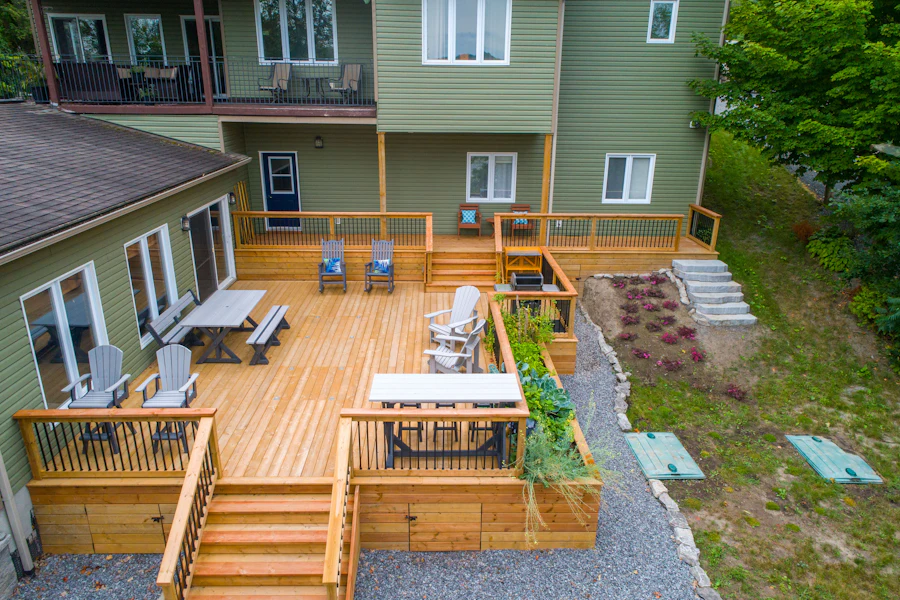
If the lot sits in a mapped flood zone, the lowest floor goes at least two feet above the base flood elevation, and a deck follows its door. Horry County's flood-damage-prevention ordinance sets that two-foot freeboard — the 2021 version asked for three feet, and council trimmed it to two in January 2023 — on the FEMA maps that took effect December 16, 2021. Most Carolina Forest decks step off a slab or crawlspace that already settled the height, but the map is worth checking before assuming a neighborhood is dry: when Hurricane Florence stalled over the coast in September 2018, Carolina Forest took more than a foot of rain while the Waccamaw crested at a record 21.16 feet in Conway, flooded Socastee and Bucksport downstream, and left more than 1,500 homes in unincorporated Horry County flood-damaged. We pull the zone for your parcel before we quote, and a deck that has been through high water gets the once-over from our storm guide before anyone stands on it.
HOAs, handled
Nearly every Carolina Forest community reviews exterior changes, and a deck project that skips the architectural request form becomes a neighbor dispute with invoices. The Farm's association, for one, says any modification to the property or the home needs approval first and won't accept an application without a surveyor's plat — where a deck's footprint and easements get drawn first. We've been through these submittals enough to make it painless — drawings, material and color specs, the site plan the committee wants — and we build the review time into the schedule so it isn't a surprise. Composite in a wood-look finish sails through most boards here, which is one more entry in the composite column.
Repair or upsize?
For an original builder deck, the math is honest but unsentimental: a few hundred dollars of board and railing fixes makes sense; a structural overhaul of minimum-spec framing usually doesn't. When the repair list crosses that line, we'll show you the numbers side by side — patch what's there, or put the same money toward the deck you actually wanted when you bought the house. For what that deck runs by size and material, the new-deck price table is public.
Your builder gave you a platform. Let's build the deck.
Also serving Myrtle Beach, Conway, Murrells Inlet, Surfside Beach & Little River.
Call (843) 380-6043